
Hexagram 56 and Esoteric Initiation
The Fire from Stillness

Divination’s Real Work
I refer to Dean Radin to define what divination is.
Divination involves perceiving beyond the ordinary boundaries of space and time. In the early nineteenth century this ability was called clairvoyance (French for “clear-seeing”). Later it was called extra-sensory perception, or ESP. Today the euphemism remote viewing is more commonly used.
Training techniques to help develop remote viewing abilities were designed by artist Ingo Swann as part of a classified program of psi research funded by the U.S. government from 1972 to 1995. Swann based his picture-drawing technique on methods used in the 1880s by British researchers Frederic W. H. Myers and Edmund Gurney, in the 1920s by the American social activist Upton Sinclair, and in the 1940s by British psychologist Whately Carington and French researcher René Warcollier.
The method involves making fast, abstract sketches of impressions gained when asked to mentally perceive a distant target image or location. This is intended to capture not only fleeting visual images but impressions from the other senses as well. The reason Swann’s technique focused on fast sketching, at least in the initial stages of remote viewing, is that the single greatest inhibitor of remote viewing ability is the analytic mind, which gets in the way. In the jargon used in this type of training, this problem is called an “analytical overlay.”
Real Magic
Tools like Tarot card reading and the Yi Jing constitute divination/remote-viewing in the sense that one wishes to view future outcomes beyond ordinary space-time. In a more mundane sense, data science, statistical/quantitative modelling, and predictive modelling all constitute divination techniques—they allow one to peer beyond ordinary space-time into a more abstract realm.
The abstract sketches that skilled remote-viewers draft of some far-away place/situation neatly correspond to abstract models and business/trading rules that nonetheless speak to some real thing in physical reality. A tarot card speaks for an archetypal situation. Aristotle writes likewise of stories.
To be an image of an action, what we see and hear on a stage must display the same interior depth that an action itself does. It is not enough that the figures before us be recognizable as Oedipus, Jocasta, and Tiresias, and go through motions, though that is the material with which the poet's activity works. From within that lowest level emerges the image that matters, of the invisible motions of a soul, as choices are made for reasons and consequences are faced. If the image on that higher level is capable of disclosing the true proportions of things to us, as the ranking of images in Plato's Sophist suggests, those proportions will have to do with the worth of choices, the respect due to the ends at which they aim, and the dignity of people who adhere to such choices for the sake of such ends. The imitations the poets offer us may be on a higher level than any originals we have managed to discern on our own.
Joe Sachs, Introduction to Aristotle’s Poetics
A wise man once said, “Economics is story-telling”. Models and archetypes of reality tell a story in one go. They speak to some inner reality, not obscured but lived by the shadows and projections of characters, dialogue, and plot.
Some of the resistance to Aristotle's discussion of poetry stems from his characterization of that activity as imitation (mimêsis), as though the poets’ work is thereby tainted as something fake, like imitation leather. This sort of resistance often links Aristotle with Plato, who is thought to have treated poets with disrespect. On that issue, it may be sufficient for us to notice that in Plato's Sophist, imitative art is said to be capable of disclosing the true proportions of things (235 C-E). Such imitations would be of no great use if we could simply read those proportions off the originals of which they are copies. But Socrates, in Xenophon's Memorabilia (III, x, 1-8), points to their true use, when he asks about the fact that paintings and sculptures can be imitations (mimêta) not only of the look of a face or a body but also of the character and acts of a soul. I can attest that a certain lump of broken stone on display at Olympia in the Greek Peloponnese can be recognized not only as a standing man and as Apollo, but as radiating a calm dignity that overpowers the violent passions of the figures on his two sides. No one would ever confuse the interior life visible there with that in another block of graven stone in a Roman church, that is recognizably a seated man, and Moses, and angry, and controlling his anger.
Action… may be one of the most important things we could ever turn our attention to, and anything that helps us see it as it is would be a high achievement. But the worth of poetry is even greater if action can become visible nowhere but in an image. An action is stretched out in time, so that even in life, we can comprehend it nowhere but in the imagination. And its origin, in the act of choice, is interior, and never available to us in another person except by an act of interpretation. Even our own choices are not always recognized when they are made, but only evident to us retrospectively. And the ends for which we and others act, by which the outcomes of our deeds must be measured, are present to us only as possibilities foreseen in imagination. In the Nicomachean Ethics, Aristotle says that an action (prakton) is known only by sense perception (1142a 25-27), and then immediately qualifies this by saying that this is not the perception of any or all of the five external senses, but the same sort by which we perceive that a mathematical figure can be divided into no figures simpler than triangles. Try it. You might begin by drawing pictures and looking at them, but you will not come to a conclusion until you turn to the imagination.
Joe Sachs, Introduction to Aristotle’s Poetics
Each Tarot card speaks of archetypes in life and living. The Emperor card, for example, refers to one who has authorship—one who dictates how the plot goes, what the characters say, what mechanics things in the world follow. The High Priest also has competence and command, but not in the physical. He crafts a liturgy of signs and symbols that have competence and command among hearts and minds—心.
The esoteric initiate has command over both.
Hexagram 56
In ancient China, people preferred staying home to travelling. However, talented and able people at times could not realize their ideals at home. These had to travel among the ducal [Warring] states to find virtuous ealdormen who would employ them. Hexagram 56 speaks to the truth of these superior men. Travelling and wandering becomes an appropriate action according to the norm of Hexagram 56 when travelling, for whatever reason, can’t be avoided.
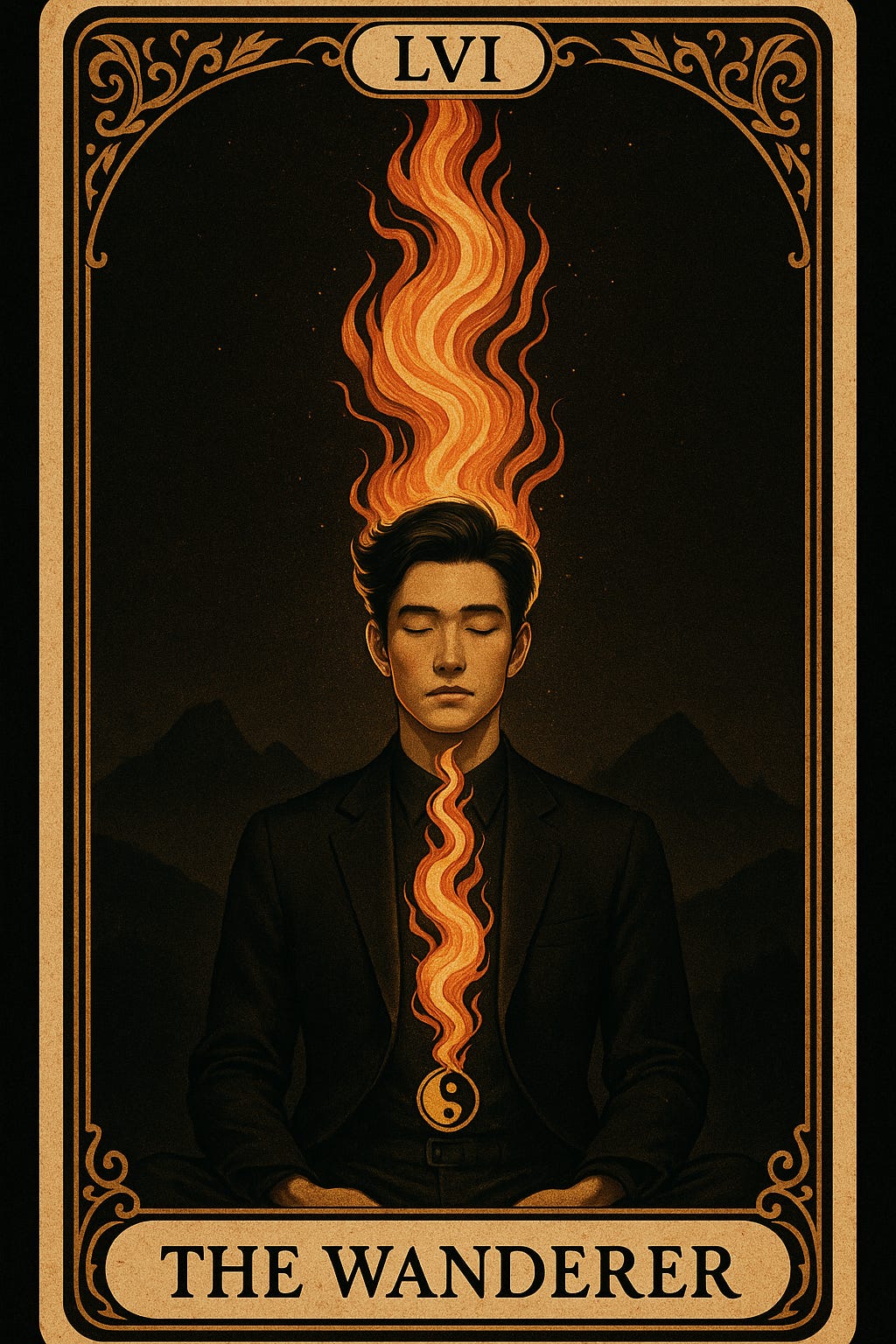
Among the eight trigrams, stillness (艮; the mountain) below and the radiance (離; the rising fire) above form Yi Jing Hexagram 56: the Wanderer. Those in the know easily grasp the image of a kundalini awakening: stillness in contemplation/meditation allows an inner fire to arise and ascend. In this configuration, Hexagram 56 becomes not merely a depiction of geographic travel or worldly displacement, but an allegory for inner transformation. The wanderer is cast into exile from its original home, and thus must seek a new home: the divine Self. The journey is fraught with ego, desire, and distraction.
In Yogic and Tantric symbolism, Kundalini Shakti lies coiled at the base of the spine, dormant in the stillness of Muladhara (root). Through meditative discipline, moral refinement, and inner aspiration, the fire rises, illumining each chakra, consuming attachments, illusions, and falsehoods. Hexagram 56 likewise has six lines speaking for the gradual ascent from lowly, quarrelsome beginnings (Line 1), to acquisition of tools and allies (Line 2), through trials and losses (Line 3), to temporary mastery (Lines 4 and 5), and ultimately to a transcendent culmination (Line 6). Fire from stillness is not just energy. It is refined consciousness, spirit awakened through the body, divinity at work, unchanging through time. The Wanderer becomes the Seer, not by conquering the terrain without, but that within.
The Fire from Stillness
The Image
艮下離上 – Gen below, Li above
Fire on the Mountain: The image of the Wanderer
Hexagram 56 is constructed from the trigram Gen (艮) below—the Mountain, stillness, stopping—and Li (離) above—Fire, radiance, clarity. Together, they form an evocative symbol: Fire traveling over the Mountain.
This visual is not merely topographical—it is psychological, mystical, and initiatory. The mountain signifies groundedness, structure, and containment, while the fire represents spirit, insight, and movement. Fire has no root; it must cling to something to remain. When it moves over the mountain, it is transient, luminous, and potentially destructive. This is man-in-transit, an initiate-in-process, the awakened flame of kundalini rising from the base of the spine (Gen) toward the illumined mind (Li).
Fire on the mountain: the image of the Wanderer.
The noble one is clear-minded and cautious in imposing punishment,
and does not prolong lawsuits.
Aristotle wrote that a man without a city is bound for war, for he is either a beast—unable to give and take with other people—or a god—for he has no need to give and take with other people. Man may abuse his power speech and fall into the vice of hubris:
Aristotle does not posit a separate human faculty of will to explain perverse and self-destructive acts, as St. Paul (Romans, 7.15) and St. Augustine (Confessions, Bk. VIII, Chap. 9) do (compare Gospel of John, 1.13), but assigns such behavior to unrestraint in one’s desires; his primary example is hubris, understood as gratuitously insulting speech or action indulged in for the mere pleasure of feeling the power to cause pain (1149b 20-26). The display of hubris is a willing act, not a willful departure from rational choice.’
Man thus may fall into an animal state by failing to watch over his words, by writing nonsense disguised as scholarly and intellectual diatribes, by failing to conform to reality yet speaking as if he were in conformance to reality while the Zhenren is expelled into the darkness outside the city by said selfsame hubris. The subhuman claims that he is the victim of the Zhenren’s excellence and has the utter gall to project his improprieties upon the Zhenren. The subhuman, having wasted his words in nonsense, faces the Zhenren’s backlash. In turn, the subhuman calls his fellow subhumans “real ones”, he denounces the Zhenren for not being as base he is, he steals and leeches resources (jobs, taxes, sentiment) from the Zhenren. The Zhenren, thus running out of options, must begin his wandering to ascend to godhood.
This ascent necessarily makes him a man bound for war. Nonetheless, the Zhenren must avoid engaging in prolonged lawsuits and other sorts of direct conflict. Thus while the external condition may be displacement or instability, the internal discipline of the traveler is crucial. The fire must be directed; the stillness must be preserved. In the end, when the Zhenren has achieved divinity, his chastisements on the animals and subhumans must be clear-minded and cautious. Yet these do not mean that the Zhenren can’t engage in a bit of fun along the way—witness a certain capital now littered with bodies lynched from street and traffic lights.
The Exposition
Hexagram 56 follows Feng (55), Abundance. Where Feng signifies excess and fullness, a house too full to hold anything more, Lu signifies the inevitable result: one must leave, wander, and grow elsewhere. Society has become overly complex, full of Apollonian miasma, decaying under Confucian rituals and Kantian categorical imperatives. The Zhenren must departure from the known, a recurring step in every spiritual journey.
“Ceaseless enlargement will result in no room to accommodate it; therefore it starts to wander and Lu is granted. Lu signifies to travel…”
The inner hexagram formed within Lu is Da Guo (28), the overburdened ridgepole, signifying inner strain and imbalance. Its changing hexagram is Jie (60), restriction, pointing to the need for self-regulation as one wanders. In other words, the fire that burns too freely must be governed by rhythm and restraint, lest it consume the traveler.
The Judgment
旅,小亨,旅貞吉。
The Wanderer. Small success. Perseverance brings good fortune.
The judgment emphasizes a qualified success—“small success”. This is not the triumph of conquest, but of navigating alien terrain with grace and tact. The advice is clear: persist in the new self-concept, in the state of the wish fulfilled. The wanderer does not engage, he observes. He moves lightly and watches deeply. He has his fun, but knows when to keep moving. The awakening fire (Kundalini, divine insight, or spiritual force) does not erupt chaotically. It arises through self-remembrance and alignment. To travel without centering is to burn without purpose.
The Lines: Six Gates of the Initiate
Each line in Hexagram 56 portrays a different phase of the journey—the spiritual, psychological, and symbolic movement of the initiate as they traverse the unknown.
Line 1 (Initial Position):
The traveler is petty and quarrelsome. He brings misfortune on himself.
This is the unprepared seeker—one who sets out with ego, complaints, and trivial ambitions. The fire has not yet been kindled with clarity; it flickers chaotically in the base of the mountain. In kundalini terms, this is the distorted stirring of root energy—not yet spiritualized, still reactive. The path must begin with purification of motive. Pettiness will bring the flame down on one’s own house. Before the path opens, it confronts the traveler with himself. Pettiness is a shield against inner work, and must burn away before the fire can rise. Misfortune is not punishment, but the first mirror.
The quarrelsomeness is not merely social, but an internal friction, the refusal to surrender control or open to the unknown. The traveler projects dissatisfaction outward, yet the dissonance is within. The fire has not yet been awakened, but the mountain already resists.
Line 2:
He rests at an inn. He has his belongings with him. He gains a young servant. Perseverance brings good fortune.
This is the first resting point. The traveler is modest, prepared, and accompanied by supportive forces (the servant as intuition, guidance, or disciplined habits). Here the initiate finds stability amid transience. Success at early stages comes through discipline, order, and inner support. The servant is practice, breath, and still mind. The fire is still low, manageable. The self is intact, but no longer reactive. This line marks the development of trust in the unfolding process.
Before awakening deepens, the initiate is granted small certainties—glimpses of purpose, small victories, inner alignment. These must not be mistaken for the goal. They are the foundation for perseverance. The “good fortune” promised here is not lasting comfort but encouragement. It is the beginning of a new self that will survive the burning to come.
Line 3:
He burns down the inn. He loses his servant. Danger.
This is the threshold of disintegration, the moment when the egoic identity begins to unravel. The “inn” is the temporary structure that sustained the traveler’s sense of self up to this point—a worldview, a relationship, a belief system. Now, it is consumed by the very fire that promised illumination.
The “servant,” a symbol of guidance or inner discipline, is also lost. But this loss is not accidental, but the sacrifice of outer supports that must occur when the initiate faces inner fire without mediation. This moment feels like danger because the ego can no longer anchor the experience. Every true path of awakening requires the burning of what once held the self. This is not regression, but the beginning of awakening and transcendence. The initiate must endure the fire without clinging to identity, to comfort, or to inherited meaning.
Line 4:
He rests in a shelter. He gains his belongings and an axe. My heart is not glad.
After the fire, the wanderer finds shelter—not a return to the old, but a temporary resting place amid the ashes. The “axe” is discernment, clarity, and a capacity to act with intention. The belongings retrieved represent fragments of the self reassembled after crisis.
But still: “My heart is not glad.”
Sober self-awareness takes over. The traveler has not regressed, but neither has he transcended. What is rebuilt here lacks the innocence of the past and the fulfillment of full awakening, a necessary pause between disillusionment and revelation. After ego-death, the initiate may seek a new identity to inhabit—but even that must eventually be relinquished. Tools are useful; clarity is hard-won. But stillness remains elusive because this shelter is not the home the soul is seeking.
The unease here is not failure, but the recognition that even the new tools cannot restore what was lost, nor substitute for what is still to come. The wanderer must learn to live without belonging.
Line 5:
He shoots a pheasant with one arrow. It falls. In the end, praise and position.
The initiate acts. Not out of petty ambition, but out of clarity. The pheasant, fleet, elusive, a creature of air and fire, is brought down with a single arrow. This is not a worldly skill; it is the mark of one who has passed through fire and stands in stillness.
This is true precision, an action free of the false self. The praise and position that follow are not just worldly rewards, but symbols of recognition by the inner order. Heaven and Earth harmonize. The awakened self acts with clarity and grace. It hits the mark, not through effort, but through alignment.
This is the last moment where the traveler can still be seen by the world, still acknowledged by its terms. Even this moment of perfect action must pass, however. What follows is not glory, but release. What follows is exile, when that recognition no longer matters, because the self who cared for it is gone.
Line 6 (Final Position):
The bird burns its nest. The traveler laughs at first, then weeps. He loses his oxen at ease. Misfortune.
This line marks the death of the old self. The nest, once a place of safety, identity, and belonging, is gone—burned by the very fire that once brought clarity. The initial laughter is the ecstatic joy of ego release. The weeping after is the grief for what can no longer be returned to. The traveler has awakened, but now stands estranged from the world that once made sense.
The “oxen” speak for not merely wealth or status, but the means of living within the old order—routine, social cues, inherited roles. With the false self gone, those means are no longer viable. What is lost is not material but metaphysical: the ability to be at home in the familiar illusion.
Thus the final threshold is non-return. Awakening dissolves the structures that once provided orientation. The initiate must now walk a pathless path—carrying no identity or home, but the new self—the higher self. “Misfortune” is not a punishment, but a natural mourning, the last shedding of skin. The nest is gone because the bird must fly.
The Exile Who Sees
Hexagram 56 tells of a traveler in strange lands. This is not merely a person who has left home, but one who is becoming someone for whom home no longer exists in any familiar form. What began as movement through space becomes a transformation through inner fire. The Zhenren strives not for progress, achievement, or external discovery. He unleashes a dismantling: the gradual burning away of comfort, identity, and place, leaving no longer a self moving through a world, but fire itself, moving from stillness.
Divination, rightly understood, is not prediction. It is not the art of saying what will happen. It is the capacity to perceive what already is, beneath appearances—the real proportions of things, as Aristotle said, which can only be seen in image, symbol, and myth. Hexagram 56 speaks to release the stories we tell ourselves, not to be empty, but to finally be clear.