
The Guilds: Origins and Evolution
History of an Institution

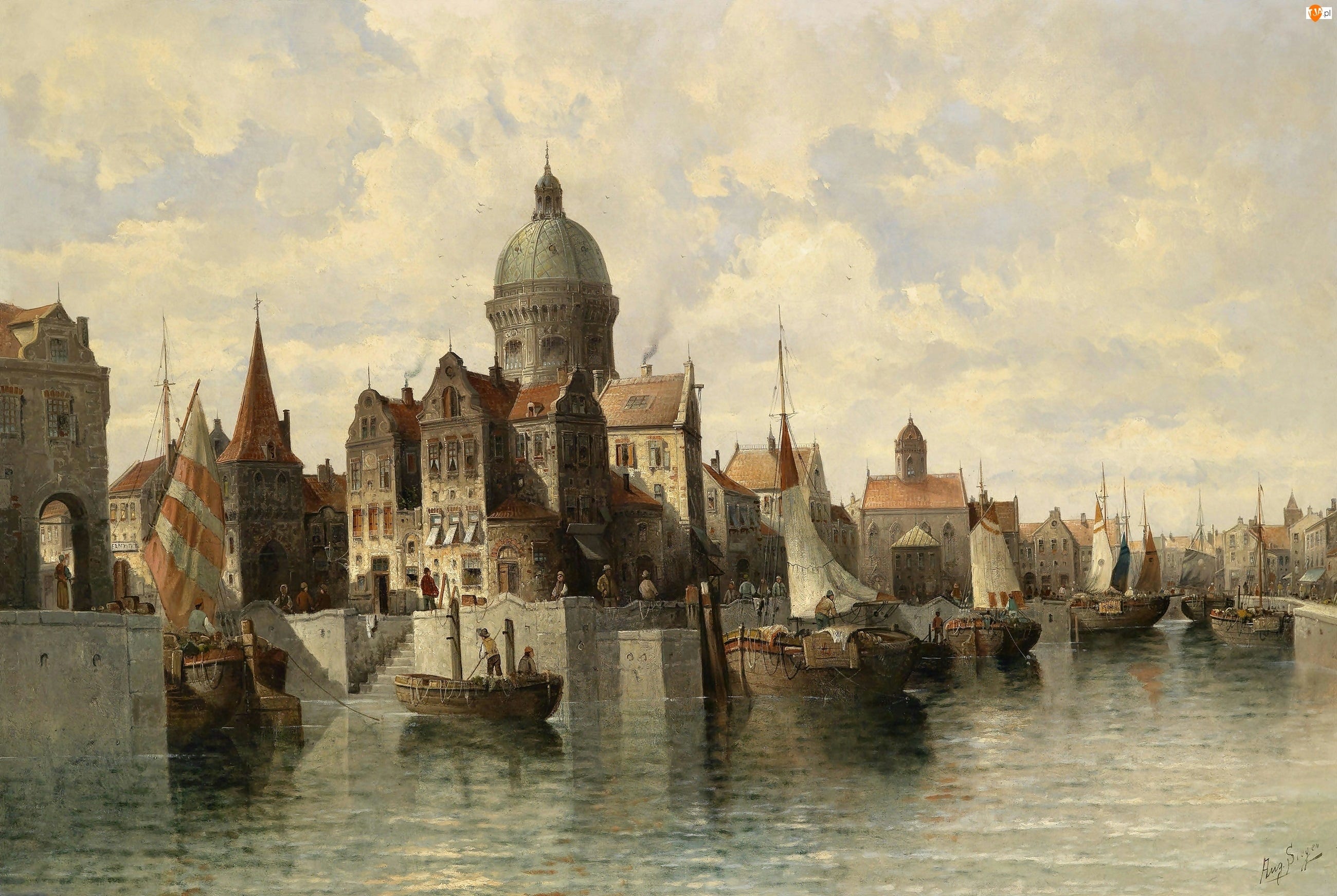
Popular notions of the medieval guilds rests on the misconception that they formed cartels, monopolies, and oligopolies. Some have even gone so far as to suggest they were a medieval equivalent to licensing and regulatory authorities, or to labor unions. This misconception is an old one, with a helpful example from Adam Smith:
People of the same trade seldom meet together, even for merriment and diversion, but the conversation ends in a conspiracy against the public, or in some contrivance to raise prices. From the Wealth of Nations, Chapter 10, Part 2.
Now we note that Adam Smith was talking about guilds in his own time in 1776. As we should know, two institutions with the same name are not necessarily the same in function or purpose. The guilds are one example of an institution that underwent a substantial change through time. They went from free and voluntary associations of likeminded workers and craftsmen in Medieval times, to restrictive regulatory agencies under royal charter in Early Modern times.
Guilds and Brotherhoods
The word guild comes from the Old English geld, meaning obligation. In a wider sense, the Germanic cognate gild also referred to meetings in general. The first recorded use of gild in the sense of association comes from a Frankish capitulary regarding meetings by townsfolk regarding stolen goods in the town of Verneuil-sur-Avre:
We wish that the priests and clerks of the count command the townsfolk not to hold a meeting, which they commonly call gild, against those who steal anything. But let them refer their case to that priest who is one of the bishop's missi [agent sent out] and to those who in these places act as clerks of the count on these matters, in order that all may be prudently and reasonably corrected. From a Capitulary of Verneuil, AD 884.
These gild meetings formed to administer mob justice against thieves, with the local bishop ordering townsfolk to let the proper authorities handle them. The next recorded mention of gilds as meetings was in England proper:
This is the ordinance which the bishops and reeves belonging to London have ordained and with weds confirmed, among our frith-gegildas [security association members] as well eorlish as ceorlish, to supplement the dooms which were fixed at Greatanlea and at Exeter and at Thunresfeld.
Capitulary 3: That we count always 10 men together, and the chief should direct the nine in each of those duties which we have all ordained; and (count) afterwards their hyndens [a 10 man association] together, and one hyndenman who shall admonish the 10 for our common benefit; and let these 11 hold the money of the hynden, and decide what they shall disburse when aught is to pay, and what they shall receive, if money should arise to us at our common suit; and let them also see that every contribution be forthcoming which we have all ordained for our common benefit, after the rate of 30 pence or one ox; so that all be fulfilled which we have ordained in our ordinances and which stands in our agreement. From the Laws of London under King Aethelstan, AD 930.
Already, we see typical guild characteristics forming: a voluntary association of men contributing to mutual aid, security, and welfare, with confirmation from a local authority that they were allowed to form a brotherhood.
The institution of the guild itself finds its roots in pagan times, with Roman collegia being a direct predecessor. These Roman groups represented numerous persons bound into a distinct and collective legal entity. The Germanic comitatus surely also influenced these brotherhoods after Western Rome fell, introducing elements of brotherhood and oaths. Brotherhoods and associations continued into medieval times, sometimes bound by oath. Clergymen were wary of their pagan origins, but the institution was baptized by introducing collective welfare, whether material or spiritual. Thus we see the guilds began and flourished as brotherhoods marked by voluntary mutual obligation, and reinforced by oaths, ceremonies, and sociable feasting. Some brotherhoods had also shifted from mere associations of like-minded men to associations based on craft and occupation. A charter from the city of Worms by Bishop Adalbert is quite telling:
Be it known . . . that Adalbert, Bishop of the venerable church of Worms, on the petition of Count Wernher, and on the persuasion and advice of his ministers, has decreed that there shall be twenty-three fishermen of Worms. To them he gave this charter on such condition: that if any of them should be assailed by and succumb to death, his nearest relative may succeed to his office by hereditary custom: but if the heir should fail to do this, let restitution of the said office be made to the common council of the townsmen. In addition the same bishop, on the advice of the above named, decreed that if any one be found to have bought fish to retail them between the two towns of Suelntheim and Altdruphen, or, if he be taken by the said fishermen while making the said purchase, the fish will be taken away from him and equally divided among the townsmen: but he who has been taken in such purchase shall be led before the judges, and, when judgment has been passed, three talents will be offered by him, two to the Mayor and the third to the Count. Those who catch fish are not prohibited from selling them, but the said twenty-three fishermen are not allowed to buy any before prime. Besides, for confirmation of this charter, lest it be subsequently destroyed by the advice or dissensions of any one, the said bishop decreed with his ban that these twenty-three fishermen in times of Rogation shall always present three salmon, two to the Mayor and the third to the Count, and they shall confirm their charter every year by such an offering.
It is this last case of productive activity that guilds are most known for, and which shall be the focus for our next section.
Cooperatives and Fraternities
After the Commercial Revolution of the Middle Ages stimulated trade in agricultural surplus, industry and manufacturing also surged in what some Medievalists call the Medieval Industrial Revolution. Far from a destitute time of manual subsistence farming, the Middle Ages introduced machinery on a scale no civilization had seen before. As we had mentioned before, decreases in the labor pool incentivized labor saving machinery in agriculture. Beyond that sector, however, the industrial sector saw a period of dynamism and growth.
In remote areas, the dominant industries were papermaking, leather tanning, cloth fulling, and so on. These industries required machines to save on time and manual labor. To give one example of how mechanized rural areas had become, all 742 Cistercian Monasteries had hydraulic systems capable of processing different raw materials – iron, olives, hops, wheat, cloth, and more. These systems produced depending on the time and place, with Northern France producing wine from grapes in good harvest, beer from hops in bad harvest, Southern France crushing olives for oil, and iron-rich areas making tools and parts, just to name a few specialties. Saint Bernard of Clairvaux himself, more famous for preaching the Second Crusade in futile alliance with Constantinople, wrote the following report on his native town’s monastery:
Entering the Abbey under the boundary wall, which like a janitor allows it to pass, the stream first hurls itself impetuously at the mill where in a welter of movement it strains itself, first to crush the wheat beneath the weight of the millstones, then to shake the fine sieve which separates flour from bran. Already it has reached the next building; it replenishes the vats and surrenders itself to the flames which heat it up to prepare beer for the monks, their liquor when the vines reward the wine-growers' toil with a barren crop. The stream does not yet consider itself discharged. The fullers established near the mill beckon to it. In the mill it had been occupied in preparing food for the brethren; it is therefore only right that it should now look to their clothing. It never shrinks back or refuses to do anything that is asked for. One by one it lifts and drops the heavy pestles, the fullers' great wooden hammers... and spares, thus, the monks' great fatigues.... How many horses would be worn out, how many men would have weary arms if this graceful river, to whom we owe our clothes and food, did not labour for us...
Where water had no course, other areas used the wind to propel their production. No one owned the wind, and this course proved fruitful as populations increased. Windmills gave less power than watermills, but at lower costs and with greater scope. This medieval invention sprang simultaneously across the Mediterranean and Near East, locals in windy, arid regions finding ways out of their drought. Europe began producing enough that Europeans even exported windmills to the Near East, as one Arab writer notes in a poem:
The German soldiers used their skill
To build the very first windmill
That Syria had ever known.
While classical Europe had a body of slaves to use for labor, Medieval Europe had no such luxury. These machines helped them save labor for more fruitful tasks.
It is in this context that cooperatives and brotherhoods flourished. Instead of rigid, bureaucratic systems of journeymen and apprentices, these were informal statuses. Journeymen were simply employees, whether itinerant or stable. Apprentices were students in the craft, whether enrolled by their parents or taught by their parents themselves. Contrary to popular belief, no set years were mandated for these, and anyone could join a cooperative or brotherhood through merit. A craftsman showing his masterpiece to brotherhood leaders is no different from an employee displaying his resume to prospective employers, other than said craftsman having a more or less equal place as most brothers in craft. These organizations engaged in production, praying for the souls of deceased members, and more. Voluntary mutual obligation, brotherhood oaths, ceremonies, and sociable feasting applied to more than production or commerce. A century after our first examples of guilds, the Dutch clergyman Elenchus wrote his complaints about fierce and lawless behavior from men of Tiel, whose regular feasts marked by drunkenness financed by a common treasury has all marks of regular guild activity. In English towns like Devon and Dorset, even small guilds financed monthly dinners for members, while sponsoring Masses and prayers for deceased members.
It is in High Medieval times, however, that productive brotherhoods made their mark on place and time. Manufacturing cooperatives produced goods meant for export to the countryside, other towns, or distant markets. Victualler cooperatives bought agricultural goods, processed them, then sold them as foodstuffs – similar to restaurants and processed food factories. Some towns and industries had no productive cooperatives and associations, all had workers and enterprises who operated outside of them. Far from cartels or monopolies, these cooperatives and associations were mere brotherhoods of likeminded men. They were not firms in themselves, but voluntary organizations of willing entrepreneurs, masters, and journeymen, with associated enterprises. One case in 1355 London showed a weaving cooperatives’ displeasure at non-member weavers:
The weavers [of London] complained to the Mayor and the Aldermen that the burellers were exercising the trade of weaving in their houses without being qualified by membership of the craft. The burellers boldly claimed the right as freemen of the city to carry on any trade or mystery. The weavers attempt to establish their sole right to their craft was so little countenanced by the city authorities, that they did not venture to appear on the day appointed; and the judgement was given to the effect that it should be henceforth lawful for all freemen to set up looms in their hostels and elsewhere, and to weave cloth and sell it at will.
Indeed, merchandise flowed freely from point of production to point of sale. No legal barriers impeded trade among towns. Authorities protected merchants from acts of violence and arbitrary taxation. Courts enforced contracts. Starting an enterprise relied on tricks and rules that were credible, predictable, and most importantly common knowledge. Gary Richardson summed up the case against monopolistic guilds as follows:
Legal monopolies in markets for manufactures were not in the interests of the men who made and enforced the law. The burdens of monopolies would have been born by the most influential men in medieval society, merchants, aristocrats, and ecclesiastics, who had vested interests in trade. The interest of merchants is obvious. Trade was their livelihood. The interests of aristocrats and ecclesiastics is less readily apparent. Lords and priests owned the rights to hold most of the realm’s markets and fairs. These events yielded large sums from tolls, taxes, fees, and rents. Those revenues rose and fell with the expansion and contraction of trade. So, the men who made and enforced the law benefited from high volumes of trade. They also had vested interests in the price of manufactured merchandise. The ability to purchase superior products was one of the principal perquisites of lordly life. Monopolistic pricing threatened that privilege, reducing the wealth of aristocrats, clerics, and merchants relative to the income of artisans and laborers. Monopsonistic pricing also threatened lords’ livelihoods. Aristocrats and clerics owned most of the flocks, forests, and minerals in the realm, and they wanted to receive high prices for those resources.
In sum, the law forbid manipulating prices and quantities and injuring competitors and consumers, regardless of the methods used. Circumventing the law was costly and time consuming. Corrupting the law was difficult and for typical craftsmen impossible. Monopolistic machinations threatened the most powerful people in the medieval world, aristocrats, ecclesiastics, and merchants, and they opposed craftsmens’ efforts to control markets. In addition, craftsmen had little (if any) incentive to act as monopolists, since monopolistic machinations would provoke retaliatory tariffs, civil suits, and criminal prosecutions. Moreover, markets for manufactured merchandise were difficult to manipulate. Manufactures were luxuries. Demand for them was elastic, and they could be shipped from one corner of the continent to another. Consumers could choose among merchandise made by many manufacturers, delay purchases of durables when prices were high, and search for better deals. Thus, manufacturers could manipulate the price of their products neither readily nor for great profit. In sum, there is no reason to suppose that manufacturing guilds possessed legal monopolies. There are many reasons to believe that they did not.
In England’s case, Richardson further notes that from a database of borough charters from 225 English towns between 1042 and 1600, at most 5% of guilds had legal anti-competitive powers. Furthermore, no town or village in the database had any powers to turn away merchants or imports made elsewhere. Statistically speaking, this means an allowance of at most 1% of all towns beyond the database having such a power. One should also note that 23 of the largest 25 towns appeared in the database, such that any other town or village with such powers barely had any effect on commerce. Indeed, the Magna Carta’s 13th clause ensured that stereotypical guild abuses like turning away merchants and rival guildsmen would never happen:
All merchants shall have free and undisturbed passage to and from England, and shall be safe and unmolested during their stay and in their travels by land and water throughout the country. No burdensome or extraordinary measures shall be levied upon them, but they shall buy and sell freely on payment only of the proper and established dues. These provisions, however, shall not apply in wartime to nationals of a country at war with us.... if we find that our merchants are safe with the enemy, their merchants shall be safe with us.
In Italy, associations likewise did not have only financial and professional aims. Their role, at least in the beginning, was to promote solidarity and mutual assistance among their members and to support religious celebrations. However, as noted by some scholars, it was precisely during the thirteenth and fourteenth centuries that this role began to diminish, and although it was never formally abolished, the change did work to the advantage of the truly institutional activities. Mutual aid and the religious guidance for the lay members became the confraternities’ prerogatives.
These cooperatives and brotherhoods never kept themselves to the city, and rural ones proliferated. In one example for the village of Gambassi in Valdelsa, Tuscany, glassmakers formed a religious confraternity for material and spiritual aid, their organization and administration lending itself to that of the first Gesuati brotherhood established by Giovanni Colombini of Siena, a merchant and senator of Siena who entered the consecrated life and established his religious order.
Richardson thus sums up how medieval guilds behaved:
Successful guilds produced quantities far beyond local or regional needs and exported ever-increasing quantities from their hometowns to rural villages, distant towns, and foreign nations. Guilds from distant towns competed against each other in those markets, where the preponderance of the population lived and where guilds sold most of their merchandise.
One, however, could object and point to the mentioned example of Worms fishermen as an example of monopoly. We note that Bishop Adalbert’s bans only buying fish for resale in Worms’s vicinity. Additionally, the council of fishermen are also banned from selling before the Liturgical Office of Prime, or 6AM in the morning. In fact, Bishop Adalbert’s charter explicitly mentions that anyone who catches fish is allowed to sell them, while imposing restrictions only on the 23 fishermen. These regulations stem from forestalling and regrating, common practices in Early Medieval and indeed later times. Forestallers bought up merchandise before it reached the market in order to drive up the price. Engrossers hoarded merchandise when expecting prices to rise. Finally, regrators purchased products and resold them in the same market at a higher price. Richardson calls them early examples of anti-trust regulation. For laymen, anti-trust regulation is meant to deter the market from anti-competitive behavior. However, medieval incidents of these offenses went beyond mere anti-competitive behavior in its graveness, and reached assault and aggression. Forestallers stalled merchants and producers from reaching the market, coercing them to give up their wares for a lower price than selling in the market would give. Potential sellers often had no choice than to accede, since the delay usually meant that no one would buy their goods anymore.
Richardson once again lays out the facts regarding forestalling and regrating in England:
In statistical terms, 5.8% of extant borough charters contain prohibitions against forestalling and regrating, and the 95% confidence interval for the percentage of all towns enshrining anti-trust provisions in their constitutional documents ranges from 2.7 to 8.8%.
Despite the relative lack of anti-competitive behavior among guilds, cooperatives, and brotherhoods, however, these groups did manage to increase their market power relative to independent producers.
Medieval Guilds and Enhanced Market Power
While the guilds, fraternities, associations, and cooperatives were decidedly not monopolies, that is not to say they competed on equal terms with independent producers. Indeed, in the 19th century, the word “monopoly” was used to denote many kinds of behavior that enhanced market power: monopoly, monopsony, monopolistic competition, imperfect competition, oligopoly, collusion, cartels, price discrimination, predatory behavior, price supports, vertical integration, barriers to entry, intra-brand-competition reducing restraints, upstream and downstream foreclosures, and countless kinds of government intervention. All of these activities generate market power and permit price manipulation, and all fell within the old notion of monopoly. Guild and fraternities were especially prone to monopolistic competition and monopsonistic behavior.
First, we begin with an Economics lesson. In the Theory of the Firm, a market may be classed on the supply-side as existing in perfect competition, monopoly, oligopoly, and monopolistic competition. A perfectly competitive market has a homogeneous good, with numerous buyers and sellers. Demand determines price, with supply moving and responding afterward. In contrast, a monopoly has only one firm in a certain area controlling price, with consumers having to make due with what price the monopolist sets. An oligopoly has few firms with a stranglehold on the market. They may cooperate in a cartel, in which case the cartels acts like a monopolist. They may also compete with each other, as Antoine Cournot and Joseph Bertrand analyzed. Lastly, a market in monopolistic competition has producers with heterogeneous goods. Different qualities, purposes, and much more ensure that a monopolistic competition sets in. It is this last class of markets that guilds often found themselves in.
While free tradesmen and enterprises could compete freely, however, joining a guild or cooperative gave advantages to productive members. Senior workers inspected all produced good to ensure quality, while penalizing members who repeatedly produced inferior ones. Guilds also had distinctive marks of their trade in their products, with guild branding and secret manufacturing processes a common sight. These steps ensured protection from fraud and counterfeiting, a common problem. In fact, chemical analysis and statistical estimates show that 1/4 of Damascus Steel swords collected by soldiers, aristocrats, landowners, merchants, and other parties in medieval times were in fact forgeries. Cooperatives and guilds made sure that everyone saw their trademarks, physical or quality-wise. These practices prefigured modern monopolistic competition since guilds supplied markedly different products from each others, often competing in niches.
On the demand side, a market may also be classed as an oligopsony, with a few number of buyers, or a monopsony, with only one buyer. In the labor market, guilds also often found themselves in these situations.
Some guilds slowed entry into their occupation locally by limiting the education of apprentices and hiring of journeymen. Other guilds monopsonized regional labor markets. A handful of weaving guilds regulated production around their towns, and with the permission of the royal government, prohibited production in the countryside, forcing rural weavers to move to urban areas where taxes could be readily collected and quality could be accurately assessed. Lastly, some guilds also had the right to require all workers in a field to pay dues—now known as taxes—to the organization.
The English census of 1388 contains two examples in clothmaking. Both weaving guilds possessed the legal right to require all of their neighbors working in their occupation to pay dues to their organization. The small number of census returns reporting this right suggests that few guilds possessed similar powers. Of guilds with extant returns, 4.08% collected mandatory contributions. Richardson notes that statistically, the 95% confidence interval for the percentage of all towns with this privilege ranges from 0.0 to 9.6%. Thus, the hypothesis that the percentage of guilds possessing limited local monopsonies approached zero cannot be rejected, while hypotheses that 10% or more possessed limited local monopsonies can be rejected. This analysis suggests that less than 10% of all guilds possessed such powers.
Nonetheless, guild charters never allowed some workers to prevent others from practicing their craft. Even if the charters had been exclusive, they would not have created monopolies in the modern sense. Sole producers in a particular place must compete with producers located elsewhere. Guilds from different towns fought for customers in the rural villages, market towns, and periodic fairs where they sold most of their merchandise. Some guilds possessed monopsony power in their hometowns, but barriers to entry were porous, and controls over input markets could be circumvented easily. So, the monopsony power was limited. As we also mentioned before, guilds that legally had these powers comprised at most 5% of all.
Despite limits on the guilds’ market power, however, some guilds’ privileges on tax collection foreshadowed a trend in early modern times.
The Modern Guild
The guilds and associations would fall from their original purpose and experience a substantial change in Early Modern Times.
In England, the first change came from Queen Elizabeth’s 1563 Statute of Artificers. While anyone with skill, merit, or even connections could make it as a worker by himself before, now no one could take up a trade or craft officially recognized in England without serving at least seven years' apprenticeship. Employment also needed one year minimum in certain fields. Employees under 30 or unmarried could not leave their employ during the year’s term without good and just cause and the approval of two Justices of the Peace or the town mayor, unless they came into an inheritance of at least 40 shillings or had property worth at least 10 livres. Those who left their employment without due cause were considered vagrant and faced heavy fines. Lastly, employers also could not let employees go without a quarter's notice, except for reasonable and sufficient cause with two witnesses.
The guilds had to adapt to this new regulation by becoming cartels. The late Tudor era introduced Intellectual Property, an import from the continent. Initial regulations linked a quid, disseminating information about new inventions, with a quo, receiving monopoly rights over the invention for a time. Lawyers and courtiers set precedents on what the quid entailed, enabling monopolies over markets for productive cooperatives and guilds. While meant to stop problems over fraud and counterfeits, patents arguably exacerbated the market power and privileges that some guilds had in medieval times. Adam Smith thus summarizes the situation of modern English guilds in the late 18th century:
In England, indeed, a charter from the king was likewise necessary. But this prerogative of the crown seems to have been reserved rather for extorting money from the subject, than for the defense of the common liberty against such oppressive monopolies. Upon paying a fine to the king, the charter seems generally to have been readily granted; and when any particular class of artificers or traders thought proper to act as a corporation, without a charter, such adulterine guilds, as they were called, were not always disfranchised upon that account, but obliged to fine annually to the king, for permission to exercise their usurped privileges. From the Wealth of Nations, Chapter 10, Part 2.
Even so, English guilds held no more than a local monopoly. Guilds from different towns still fought for customers in rural villages, market towns, and periodic fairs. However, gone were independent producers and competing cooperatives, for the stereotype of guilds holding cartel over a single town had set into place.
One may remember above that intellectual property is a continental invention. Over there, fraternities and brotherhoods remained heterogeneous, but the same trend as in England developed. These dominated local government, stemming from earlier tax collection privileges. Similar events occurred: labor regulations allowed the guilds to set quotas on new entrants, with Augsburg and Frankfurt notably restricting new master entrants yearly. In the Dutch city of Haarlem during the 1630s and 40s, painters’ guild officials helped organize public auctions, raffles, and lotteries to stimulate demand, while condemning them in assemblies and squares as damaging and disrespectful to artists. Half a century later, Haarlem tailors demanded that fewer seamstresses be accepted lest profits go down. We find that guilds increasingly became bureaucratic, formal in regulations and bylaws, and prone to internal conflict.
Despite these developments, the reality of modern guilds still falls short of many stereotypes. Most new members came from outside the city. Members’ children rarely supplied more than 20% of new blood. Only in smaller towns and villages did preferential treatment to relatives occur more frequently. Foreign apprentices were also a common occurrence, with almost two-thirds of guilds recruiting half of their apprentices from foreign lands. Far from an exclusive institution, the modern guild was still welcoming and open to new members. However, we must emphasize that regardless of inclusivity, the guilds’ bureaucratic corruption made these institutions extractive. Daron Acemoglu, a Turkish Economist, argues that institutions must be inclusive rather than extractive for a nation-state to survive, and that these traits are mutually exclusive in a dichotomy. The guilds’ example proves otherwise, with both inclusivity and extractiveness dominating in Early Modernity. Their downfall in the 19th century coincided with Western governments experimenting with new ways to support monopolies in business.
As the guilds fell, governments turned their support to a burgeoning type of firm, called the limited-liability corporation. Frederick Kempin points out how revolutionary this shift was:
The fact that corporations had not, historically, been the form of organization of manufacturing enterprises, and therefore were an innovation, must in itself have been a strong influence against the free granting of charters. Also, corporations had long been associated with the concept of monopoly. Indeed, the granting of corporate privilege, with limited liability, was itself considered to be a type of monopoly, by way of legal privilege if not by way of trade or product, that was anti-democratic in nature. If the small, unincorporated businessman was subject to total financial ruin in a business failure, the argument ran, why should the corporate stockholder be exempt from the same risk? From Limited Liability in the Historical Perspective.
Some guilds already had limited-liability privileges stemming from local government privileges. However, the East India Company’s formation in 1600 planted the seeds of how business would be done for the next half-millennium. Governments had already colluded with guilds in a sort of dry-run to further support of monopolies in business. Once the guilds had stagnated, governments simply abandoned them and switched their focus to more efficient monopolies. The early modern guilds’ downfall sheds light on how an age-old institution fell to stagnancy, and should serve as a warning for entrepreneurs to come.
References
Gimbel, J. (1977). The Medieval machine: The industrial revolution of the Middle Ages.
Kempin, F. G. (1960). Limited liability in historical perspective. American Business Law Association Bulletin, 4(1), 11-34. https://www.bus.umich.edu/KresgeLibrary/resources/abla/abld_4.1.11-33.pdf
Lopez, R. S., & Lopez, R. S. (1976). The commercial revolution of the Middle Ages, 950-1350. Cambridge University Press.
Prak, M., Crowston, C. H., De Munck, B., Kissane, C., Minns, C., Schalk, R., & Wallis, P. (2020). Access to the trade: monopoly and mobility in European craft guilds in the seventeenth and eighteenth centuries. Journal of Social History, 54(2), 421-452. https://academic.oup.com/jsh/article/54/2/421/5644454
Reynolds, S. (1984). Kingdoms and communities in Western Europe, 900-1300. Clarendon Press.
Richardson, G. (2001). A tale of two theories: monopolies and craft guilds in medieval England and modern imagination. Journal of the history of economic thought, 23(2), 217-242. http://socsci-dev.ss.uci.edu/~garyr/papers/Richardson_2001_JHET.pdf
Richardson, G. (2004). Guilds, laws, and markets for manufactured merchandise in late-medieval England. Explorations in economic history, 41(1), 1-25. https://www.socsci.uci.edu/~garyr/papers/Richardson_2004_Explorations-in-Economic-History.pdf
Richardson, G. (2008). Brand names before the industrial revolution (No. w13930). National Bureau of Economic Research. https://www.nber.org/papers/w13930
Richardson, G., & McBride, M. (2009). Religion, longevity, and cooperation: The case of the craft guild. Journal of Economic Behavior & Organization, 71(2), 172-186. https://www.nber.org/papers/w14004
Salvestrini, F. (2017). Fraternilies, guilds, social welfare, and art in Medieval and Renaissance Florence. In L'assistència a l'edat mitjana (pp. 153-168). Pagès editors. https://web.archive.org/web/20220308091744/https://core.ac.uk/download/pdf/301573515.pdf